Direction for use
1.safe
a. Safety
signs The safety signs used in this machine are described below. Please fully understand the correct location of the safety sign and the danger and danger avoidance methods shown in the sign. Safety signs shall always be kept clean to be read correctly. When cleaning signs, do not use organic solvent or gasoline, otherwise it will peel the safety signs. If the safety sign is damaged, lost or cannot be read normally, use a new one. Besides the safety signs, there are other signs on this machine. Treat the signs in the same way.
b. Basic considerations toe the mark
Only the trained and qualified personnel can operate the machine. During the operation, inspection and maintenance of the machine, follow all safety precautions and steps in this manual. Do not operate the machine if you are in poor condition, under medication (sleepy) or alcohol, or mentally unstable.
ⅠWhen an exception is found
If any abnormality of the machine (noise, vibration, odor, incorrect instrument display, smoke, oil leakage, abnormal alarm device or monitor display) is found during operation or inspection and maintenance, immediately report to the responsible person and handle it appropriately. In the exclusion of anomalies Before, do not operate.
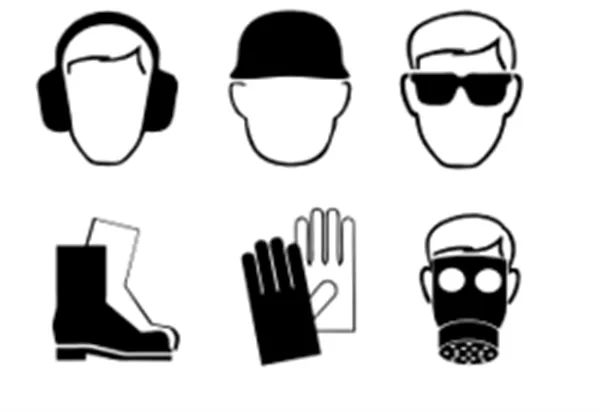
ⅡWear appropriate work clothes and wear protective equipment
Dont wear loose clothes and accessories. They have the danger of holding the control lever or other protruding parts. If the hair is too long and the helmet is stretched out, it can be getting into the machine. So tie your hair up there to avoid being caught up in the machine.
Ⅲ Equipped with a fire extinguisher and a first-aid kit
In case of a fire or a major personal accident, the following precautions must be observed. In order to prevent fire, the setting place of fire extinguisher should be confirmed and the use method should be familiar. The fire extinguishers should be checked and maintained regularly. The storage place of the first-aid kit shall be determined. In addition, drugs should be checked regularly and added if necessary.
Ⅳ Keep the machine clean
If the electrical system enters the water, there is a risk of poor work or misoperation. Do not flush the electrical system with water or steam (various sensors, alternators, starter solenoids, or connectors). When up and down the machine and conducting inspection and maintenance when it has mud or oil, there is a risk of slipping, falling, or getting dirt or dirt into the eye. Keep the machine clean at all times.
Ⅴ Do not jump on, on or off the machine
Do not jump on, on or off the machine. Not moving up or down. If the machine begins to move when there is no operator, do not jump on the machine and try to stop the machine.
Ⅵ No one is allowed on the attachment
Do not let anyone sit on the attachment, because there is a risk of causing a major personal accident such as falling.
Ⅶ Be careful not to get clamped up
Due to the action of the link rod, the peripheral gap of the working device will change. If caught, it may lead to a serious personal accident. Personnel shall not be close to all rotating and expansion parts.
Ⅷ High temperature oil
When checking or discharging oil, in order to prevent the ejected hot oil or scalding due to the hotparts, you should first confirm that the hot oil is cooled to the temperature of the lid or screw cap by hand, and then slowly release the cover or screw plug to release the internal pressure and remove the cover.
Ⅸ Prevent fire
Fire caused by the fuel oil or engine oil Fuel oil, engine oil, etc., if close to the open fire, there is a risk of being ignited. The following matters shall be strictly observed. Do not smoke or use any open flame near the fuel or engine oil. Turn off the engine before adding fuel. Do not leave the machine when adding fuel and oil. Tighten the fuel oil and the fuel tank cap securely. Do not allow fuel to spill on overheated surfaces or components of the electrical system. Fuel and oil should be stored in well-ventilated places. Oil and fuel oil should be kept in the designated place, and irrelevant personnel should not be close to it. After refueling, erase the spilled fuel, lubricants, and grease. When grinding or welding the machine, flammable materials shall be moved to a safe place. To use non-flammable oil to clean the parts, etc. Light oil and gasoline are easy to catch fire, so do not use them. Oil-stained cloth or other flammable materials should be put in a safe container and kept in a safe place. Do not weld or torch lines or tubes containing flammable liquids. Fire is caused by the accumulation or attachment of flammable materials. Remove dead leaves, wood, paper, dust and accumulated on or stuck to the engine exhaust manifold, silencer, battery or inside the bottom cover. Fire caused by a wire A short circuit of the electrical system can cause a fire. Keep all wire connections clean and firmly secured. Check the wires daily for loose or damaged. Tighten the loose connector or wire clamp, and repair or replace the damaged wires. Fire caused by the piping Check that all hoses and tube clips, shields and cushions are firmly in place if loose, it will vibrate and rub with other parts during the operation, leading to hose damage and high-pressure oil ejection, causing fire hazard or personal accident.
Ⅹ Safety at the operation site
Before starting the operation, thoroughly check the operation site for any abnormal dangerous situation. There is a risk of fire when working near thatched roofs, dry leaves or hay, so take care. Check the ground and soil quality of the operation site, and determine the safest operation method. Do not work in places where there is danger of landslides or rockfall. If there are water, gas or high voltage lines buried under the site, contact utilities and mark their location, and be careful not to damage any buried lines. Take the necessary measures to prevent any unauthorized personnel from entering the work area. In particular, when working on the road, commanders or fences should be configured to ensure the safety of passing vehicles and pedestrians. When walking or working in shallow or soft water, check the ground, terrain conditions, water depth and flow speed before working.
Ⅺ Note that the machine rolls over easily when working on the loose ground
Avoid walking or working near cliff edges, road shoulders and deep ditches. In such areas, the ground is soft, and if it collapses under the weight or vibration of the machine, there is a danger of the machine falling or tipping. It should be noted that the soil is soft after heavy rain, blasting or after earthquake. When working on the soil pile or near the excavated trench, there is a danger of soil collapse due to the weight and vibration of the machine. Take steps to ensure safe ground and prevent the machine from tipping or falling.
Ⅻ Do not get close to the cable
Do not walk or operate the machine near the cable, which is the risk of electric shock and major personal accident. Follow the following steps where the machine may be close to the cable. Before starting the operation near the cable, notify the local power company and ask them to take the necessary measures. Only close to the high voltage cable will also suffer from electric shock, so to ensure the safe distance shown in the right table. For the voltage, please confirm to the power company. In case, wear rubber shoes and rubber gloves, lay a rubber mat on the drivers seat and watch the exposed part of the body not to touch the body.If the machine is too close to the cable, a signalman shall be provided. In order to prevent electric shock, do not let irrelevant personnel work near the machine when working near the high-voltage cables.